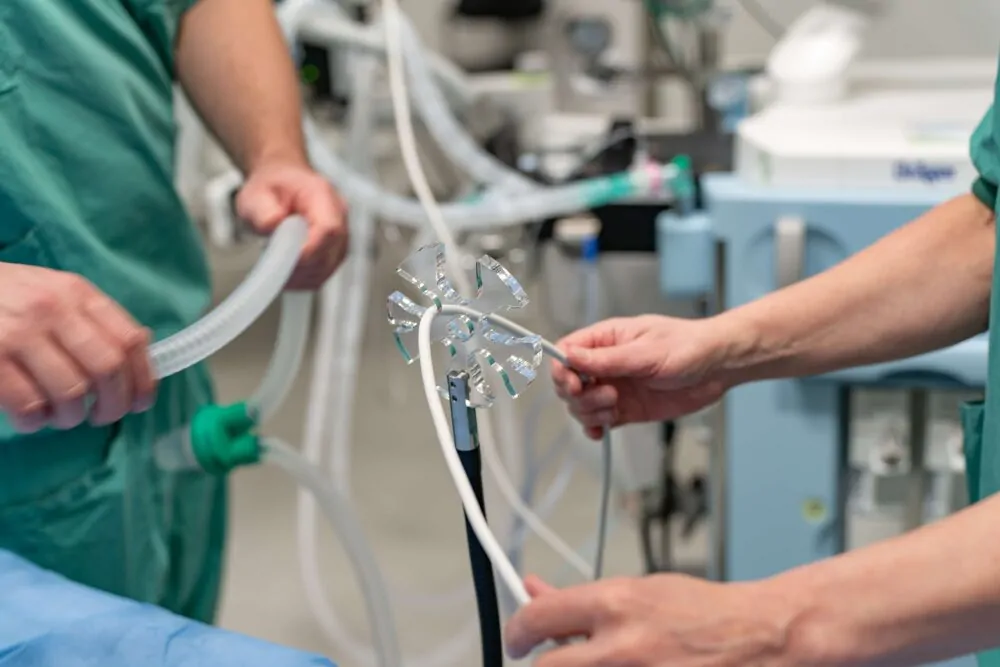
Tubes and cables are rarely on anyone’s equipment list, and they are reliably the thing in the way. Here is how to decide what holds them.
The Problem Nobody Specifies For
You specify the operating table, the armboards and the supports, and all three get compared properly before anyone signs an order. The tubes and cables that arrive with the anesthesia machine, the diathermy and the suction are on nobody’s list. They end up draped wherever there happens to be room, and by the time the drapes are on it is not always obvious which line runs where.
That is a daily nuisance rather than a crisis. It is also the kind of thing equipment can fix, which is why it is worth raising the next time your department orders accessories.
What Happens When a Line Is Not Held
A line that is not secured pulls. Reison describes the purpose of its velcro tube holder in those terms: keeping tubes and catheters in place prevents them from pulling or tugging on the skin. The same slack that tugs at your patient is the slack that catches when the table is repositioned.
The second effect lands on your team. Retrieving a line that has migrated under the drapes is a small interruption, and in a full list it rarely happens only once.
One Holder, or Several
Reison’s tube holders are built for different amounts of clutter, so the choice is really about how many lines arrive and where they arrive from. The Tube Holder Easy, Part no. 10-612, is made from PMMA plastic, bent at 90 degrees, and carries sockets at both ends for cables of 8 mm, 20 mm and 30 mm diameter. Its asymmetrical sides allow flexible height adjustment.
The Tube Holder Robust, Part no. 10-613-EU, is the other end of the range and is described in the catalog as suitable when you need to collect many tubes in one place. Its long flex arm is steplessly adjustable and the lower part locks into a clamp that can be raised and lowered. The sockets take diameters from 3 mm to 18 mm. Part no. 10-610 small and 10-611 large sit between the two.
For a line that has to travel with the limb rather than sit on the rail, the velcro holder, Part no. 300.113, uses a quick release so it can be adjusted during the procedure without unthreading anything.
Matching the Holder to the Room
The right choice depends on where your lines arrive and on how much your table moves during a case. Choose the larger rail-mounted holders when:
- Several lines arrive at the same corner of the operating table
- The tubes vary in diameter and need one place to gather
- The table will be repositioned part way through the procedure
- You want the lines off the patient and onto the accessory rail
- The case is long enough that a migrated line will cost you twice
Choose the velcro holder, Part no. 300.113, instead when the line has to stay with the limb and be released quickly.
Fitting It to Your Own Rails
Rail standards differ by market: 25 x 10 mm in the EU, 1¼ x ¼ inches in the UK and 1⅛ x ⅜ inches in the US. Confirm which your tables use before ordering anything. The hook-on clamp is what makes a holder quick to fit, and that clamp is specific to the rail it was made for.
The full range is listed in the product catalog at reison.se, with weights, materials and part numbers for every version. Spare parts are identified in the exploded view at the back of each user manual.
What holds your lines today is probably whatever was nearest to hand. Reison sends products out on trial for around two weeks on return terms. To arrange one, write to info@reison.se.
Insights