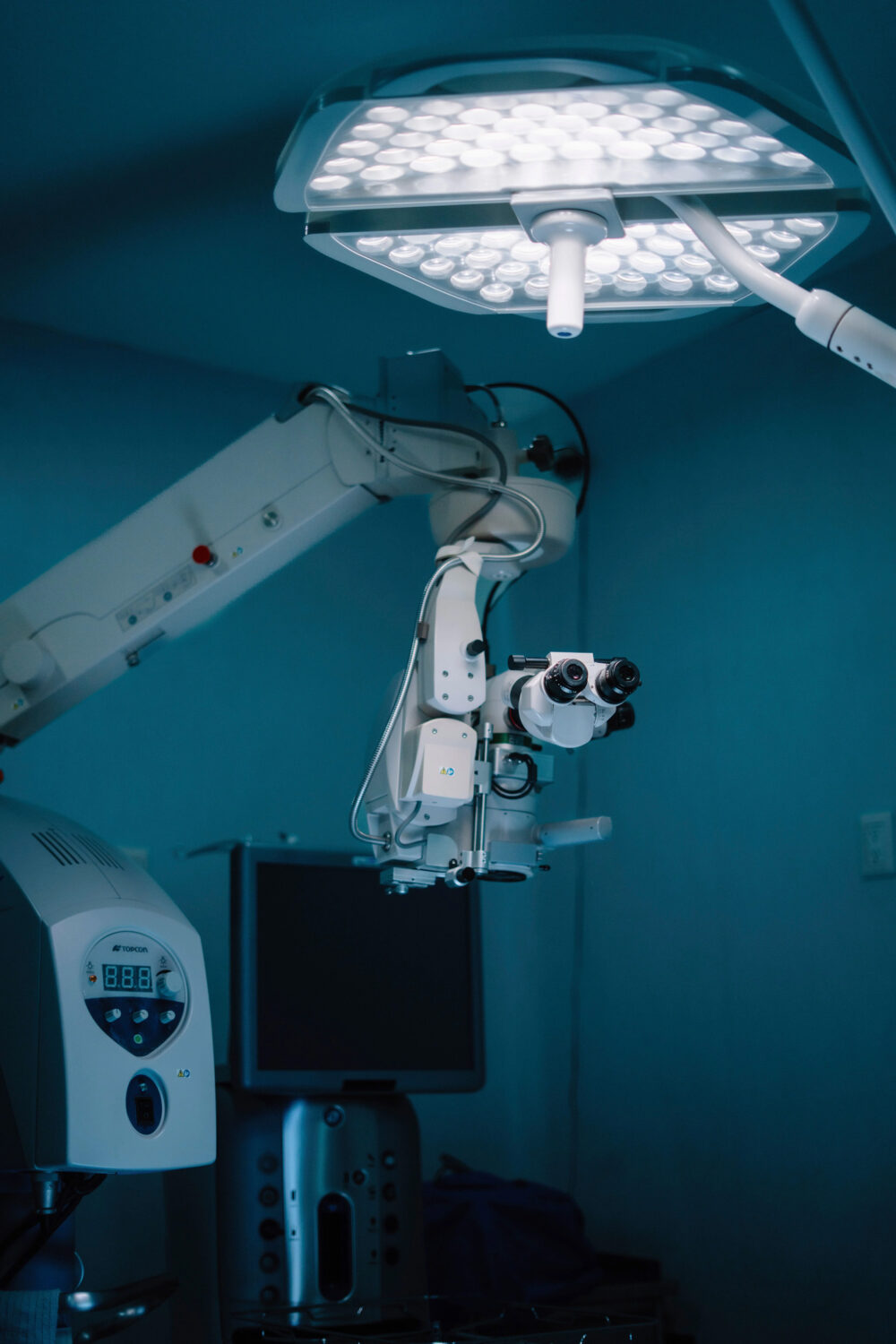
A robot changes what can occupy the space beside your operating table. The accessories have to work around it rather than the other way round.
Less Room, and Less Room to Move
Your operating table has not changed, but what stands around it has. A robotic system puts large arms over the patient and needs clearance to move through its full range, and that clearance comes out of the space your accessories and your team used to occupy.
The constraint is not only footprint. It is the swept path of the arms across the whole procedure, which is considerably harder to picture than a measurement taken with everything sitting at rest.
Shielding Patient and Staff From the Arms Above
Reison makes a Robot Shield for this, Part no. 10-316, described in the catalog as a guard used to ensure that patients and staff are protected from potential hazards when surgical robots are in use. In the horizontal position the guard can be angled and then locked in place.
It measures 665 x 350 x 650 mm, weighs 4.8 kg and carries a Safe Working Load of 10 kg, and the 10-304-P clamp is included. Those numbers matter in a turnaround, because 4.8 kg is what somebody has to lift onto the rail between cases.
Cables Get Worse, Not Better
A robot adds cables and removes none of the ones you already had. Gathering them matters more here than in a general operating room, because a line that drifts into the path of an arm becomes somebody’s problem in the middle of a procedure.
Reison’s tube holders attach to the accessory rail with a hook-on clamp, and the range runs from Part no. 10-610 small through 10-611 large and 10-612 easy to 10-613-EU robust. The Robust version takes sockets from 3 mm to 18 mm and is intended for the case where many tubes have to be collected in one place.
Judging an Accessory for a Robot Room
The test is different from the one you would apply in a general theater, because clearance rather than access is usually the binding constraint. Choose an accessory for a robot room when:
- It clears the arms through the full swept path, not only at rest
- It can be fitted or removed without disturbing the drape
- The material and cleaning instructions match your reprocessing protocol
- The rail standard matches every room the system is used in
- One person can lift it into place during a turnaround
Confirm It Against Your Own Setup
No Reison accessory is specified against a named robotic system. What is published is the rail standard, the weight, the load rating and the material, and everything after that depends on your table, your mattress and the system you run. Check compatibility in your own room rather than assuming it transfers.
User manuals, Declarations of Conformity and the ISO 13485:2016 certificate are downloadable at reison.se, and every article carries a unique UDI number for your equipment register.
Clearance is easier to judge with the equipment in the room than on paper. Reison sends products out on trial for around two weeks on return terms. To arrange one, write to info@reison.se.
Insikter